
Hey there! As a sodium sulfite supplier, I often get asked about how sodium sulfite reacts with bromine. It's a pretty interesting topic, and I'm excited to share some insights with you.
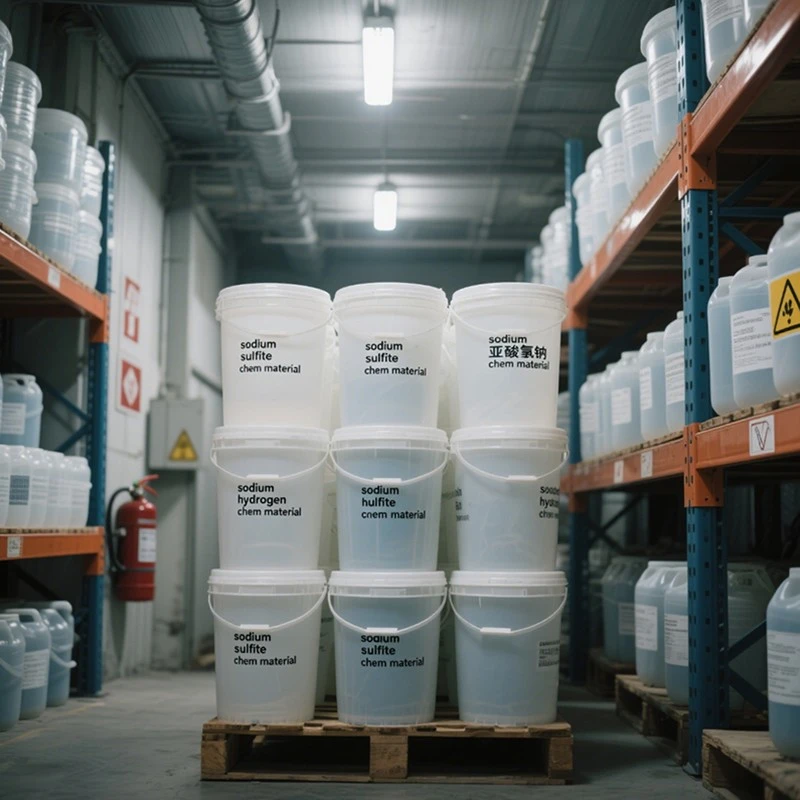
First off, let's talk a bit about sodium sulfite. Sodium sulfite comes in different forms, like Sodium Sulfite Anhydrous. It's a white, crystalline powder that's widely used in various industries. Another related product is Sodium Hydro Sulphite, which also has its own set of applications. And then there's Sodium Hydrogen Sulfite Chem Material, which is another variation of the sulfite family.
Now, when it comes to the reaction between sodium sulfite and bromine, it's a classic redox reaction. In simple terms, a redox reaction involves the transfer of electrons between substances.
Let's break down the reaction step by step. The chemical formula for sodium sulfite is Na₂SO₃, and bromine exists as Br₂. When these two substances react in an aqueous solution (that means they're dissolved in water), the following reaction occurs:
Na₂SO₃ + Br₂ + H₂O → Na₂SO₄ + 2HBr
In this reaction, sodium sulfite (Na₂SO₃) gets oxidized. Oxidation is the process of losing electrons. The sulfur atom in sodium sulfite has an oxidation state of +4. During the reaction, it loses electrons and its oxidation state increases to +6 in sodium sulfate (Na₂SO₄).
On the other hand, bromine (Br₂) gets reduced. Reduction is the gain of electrons. The bromine atoms in Br₂ have an oxidation state of 0. After the reaction, they gain electrons and form hydrogen bromide (HBr), where the bromine has an oxidation state of -1.
The reaction is quite fast and exothermic, which means it releases heat. You can actually observe some visible changes when this reaction takes place. The brownish - red color of bromine solution fades away as it gets consumed in the reaction. This is a good visual indicator that the reaction is happening.

Now, why is this reaction important? Well, it has several practical applications. In the water treatment industry, sodium sulfite is sometimes used to remove bromine from water. Bromine can be present in water due to various reasons, like disinfection processes or industrial discharges. By adding sodium sulfite, the bromine can be effectively neutralized, making the water safer and more suitable for further use.
In the chemical manufacturing sector, this reaction can be used to synthesize other compounds. For example, the hydrogen bromide (HBr) produced in the reaction can be used in the production of other bromine - containing chemicals.
As a sodium sulfite supplier, I've seen firsthand how important this reaction is for our customers. Many of them are in industries where they need to control the levels of bromine in their processes. Whether it's for water purification, chemical synthesis, or other applications, sodium sulfite provides an effective solution.
If you're in an industry that deals with bromine and are looking for a reliable way to manage it, sodium sulfite could be the answer. Our sodium sulfite products are of high quality and are available in different grades to meet your specific needs.
We understand that every customer has unique requirements. That's why we're always ready to work with you to find the best solution. Whether you need a small quantity for a research project or a large - scale supply for an industrial process, we can accommodate your needs.
If you're interested in learning more about our sodium sulfite products or have any questions about the reaction with bromine, don't hesitate to reach out. We're here to help you make the right choice for your business. Contact us to start a discussion about your procurement needs. We're eager to partner with you and provide you with the best sodium sulfite solutions.
References
- Atkins, P., & de Paula, J. (2014). Physical Chemistry for the Life Sciences. Oxford University Press.
- Chang, R. (2010). Chemistry. McGraw - Hill Education.